

CLINIC CONSULTATIONS
If you would like to find out more about the risks and benefits of different hair treatments, our Clinics specialise in all aspects of hair and scalp health. We will be delighted to welcome you.
During a keratin treatment, your stylist will use a mixture of strong chemicals to apply a coat of protein (keratin) to your hair. This process seals your hair’s cuticle (protective outer layer), to prevent the movement of moisture in and out of your strands. Your stylist will rough-dry your hair, then finish it off using a flat-iron, to seal and activate the coating.
The treatment usually takes about 1-3 hours, and lasts about 3 months. (A keratin treatment is different from hair relaxing, or chemical straightening, which lasts until your hair grows out.)
Keratin treatments can be very effective if you have coarse or unruly strands. However, as with any treatment involving strong chemicals and high heats, there are risks involved to your hair.
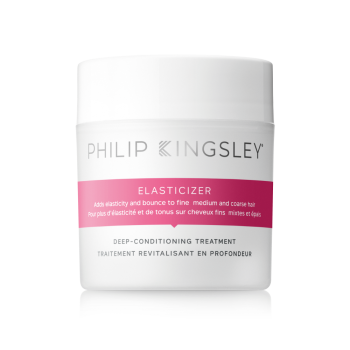
This coating process, and the heat used to seal it, can leave hair drier and more prone to breakage in the weeks that follow. A pre-shampoo deep-conditioning treatment such as Elasticizer helps moisturise hair and improve its elasticity beforehand, so it's better prepared to withstand the process without losing strength or length. Elasticizer is a moisture treatment, not a protein or keratin treatment, so it complements a keratin service rather than duplicating it.
Discover Elasticizer
Are Keratin Treatments Harmful to Your Hair?
Keratin treatments can be extremely satisfying, especially if you have frizzy, hard-to-manage strands — and we know how important it is to feel happy with your style.
However, we urge you to be careful if you decide to go for one. The high heat and strong chemicals used in keratin treatments risk making your hair dry, brittle and prone to breakage. People with fine hair and/or already processed hair should be especially wary, since their more delicate strands may not be able to withstand the treatment without breaking.
Keratin itself is not detrimental to your hair. However, keratin treatments require the application of ceramic irons to seal them, at a minimum temperature of 230˚C (450˚F).
Companies that make and/or supply keratin treatments often claim they improve your hair’s condition. But this is not strictly true. Your hair may look healthier after a keratin treatment, but this is because smooth hair often appears to be in better condition than frizzy hair, since it reflects light better and therefore produces more shine.
Your hair’s condition might improve gradually if you decrease your use of heat-styling aids. You may also be encouraged to wash your hair more frequently after a keratin treatment, since your styling time will be shorter. Frequent washing is known to improve your hair’s condition, feel and appearance.
Keratin Treatments and Formaldehyde
Keratin treatments are often associated with formaldehyde. While they do not actually contain formaldehyde (because formaldehyde is a gas), many contain ingredients that release formaldehyde when they are heated or mixed with water. Examples include methylene glycol, methanediol, methanal and formalin.
These chemicals are extremely effective sealers — they are the ingredients that keep your hair smooth and frizz-free. However, formaldehyde is a known irritant and carcinogen, so we urge you to be cautious. There are some keratin treatments on the market that are formaldehyde-free, but they tend to be less powerful and long-lasting.
We recommend you do your research, as well as talk to your stylist, before deciding on which keratin treatment might be right for you.
If you would like to find out more about the risks and benefits of keratin treatments, our Clinics in London and New York specialise in all aspects of hair and scalp health. We will be delighted to welcome you.
Keratin Treatments & Breakage FAQ's
Does a Keratin treatment weaken hair?
Keratin treatments can leave hair more vulnerable to breakage in the short term, since the coating and heat-sealing process can leave hair drier. Preparing hair beforehand with a moisturising pre-shampoo treatment can help improve its condition and resilience.
How can I stop my hair breaking after a Keratin treatment?
Keep up a regular deep-conditioning routine, avoid over-washing, and use a pre-shampoo treatment like Elasticizer once or twice a week to help restore elasticity and resilience.
What should I use after a Keratin treatment?
It helps to apply a deep-conditioning mask in the weeks leading up to the treatment, to moisturise hair and reduce the risk of breakage once the chemical process begins.
Can I use Elasticizer on Keratin-treated hair?
Yes. Elasticizer is a pre-shampoo deep-conditioning and moisture treatment, not a keratin or protein treatment, so it is applied before washing and rinsed out without interfering with a keratin service's finish.
Can Keratin treatments cause split ends?
Keratin treatments don't cause split ends directly, but the heat and chemical processing involved can leave ends more vulnerable to splitting over time. If you're already noticing split ends, our guide to split ends covers how to spot and prevent them.